If you could change only one thing about your coffee setup — just one — it should be your grind size. Not your brewer, not your beans, not your water temperature. Grind size. Because it doesn't matter how good your beans are or how expensive your brewer is if your grind is wrong. A $50 bag of Geisha coffee ground at the wrong setting will taste worse than a $10 bag ground correctly.
And yet, grind size is the variable most people get wrong. Not because they don't care, but because the information out there tends to be vague. "Medium grind" — what does that even mean? Medium like table salt? Medium like sand? Medium like breadcrumbs? This guide aims to make it concrete. We'll walk through each major grind size, what it looks like, and which brewing methods it belongs with.
Why Grind Size Controls Everything
Here's the physics: coffee extraction is a surface area game. The smaller the particles, the more surface area is exposed to water per gram of coffee. More surface area means faster extraction. Faster extraction means more of the coffee's compounds dissolve into your cup in a given time.
The compounds in coffee extract in a specific order: first come the acids and fruit flavors (bright, sour, sweet), then the sugars (caramel, chocolate), and finally the bitter compounds (the heavy, astringent stuff). Your grind size, combined with brew time, determines where on this spectrum you land. Grind too fine for your method and you'll over-extract — pulling out too many bitter compounds. Grind too coarse and you'll under-extract — getting only the sour acids without the sweetness and body that balance them.
The goal is to match your grind to your brew time. Fast methods (espresso, 25-30 seconds) need a fine grind to extract enough in that short window. Slow methods (French press, 4 minutes) need a coarse grind so they don't over-extract during the long steep.
The Grind Size Spectrum
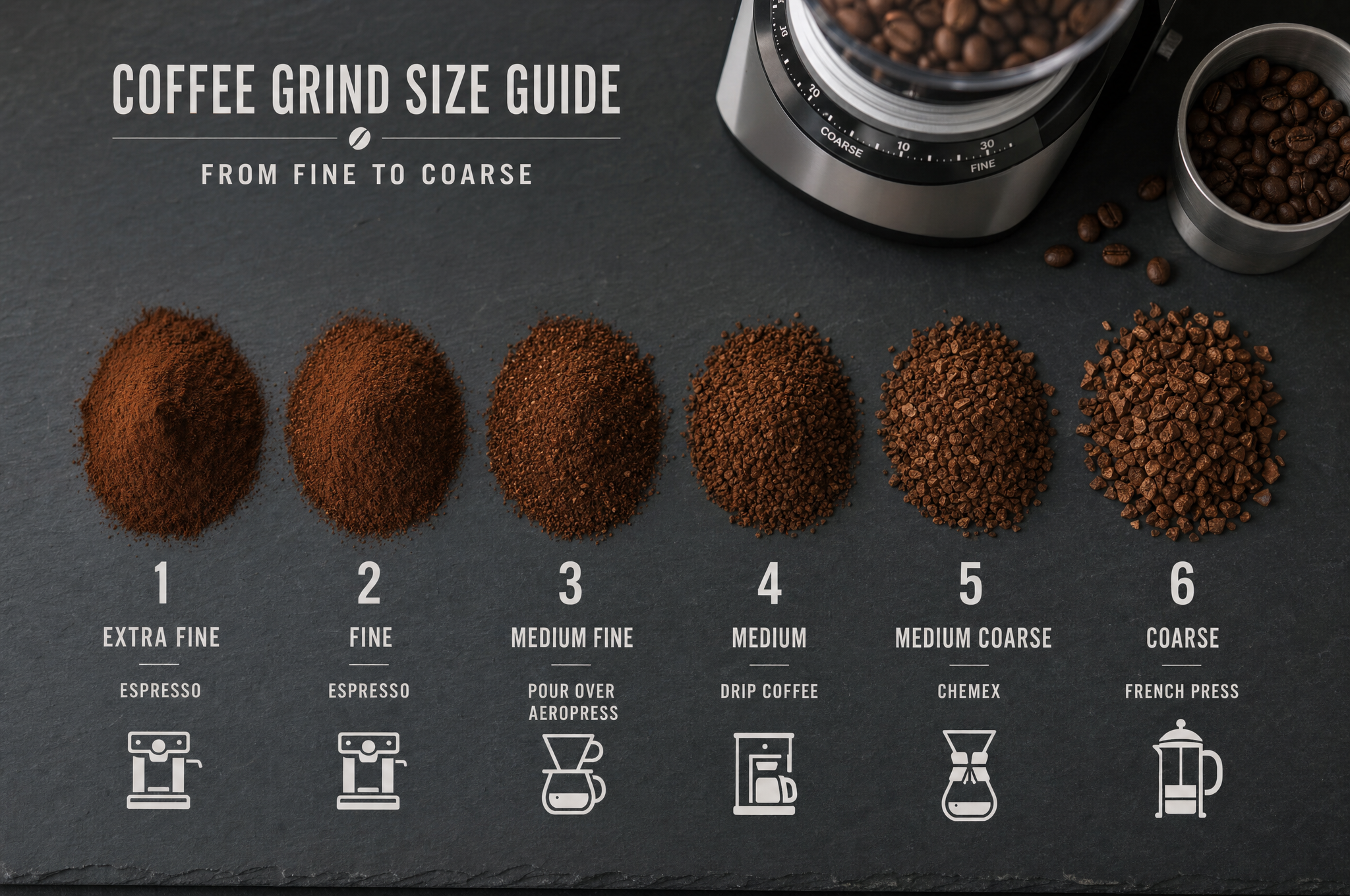
Let's walk through the spectrum from fine to coarse. For each, we'll give you a visual reference (something you can compare to in your kitchen) and the brewing methods it suits.
1. Extra Fine (Powdered Sugar)
Looks like flour or powdered sugar. When you pinch it, it clumps and feels like dust. This is Turkish coffee territory — the grind is so fine that it's essentially dissolved into the water, creating a thick, intense brew with grounds settling at the bottom of the cup. Turkish is the only method that uses this grind, and it requires a specialized grinder (most standard burr grinders can't go this fine).
2. Fine (Table Salt)
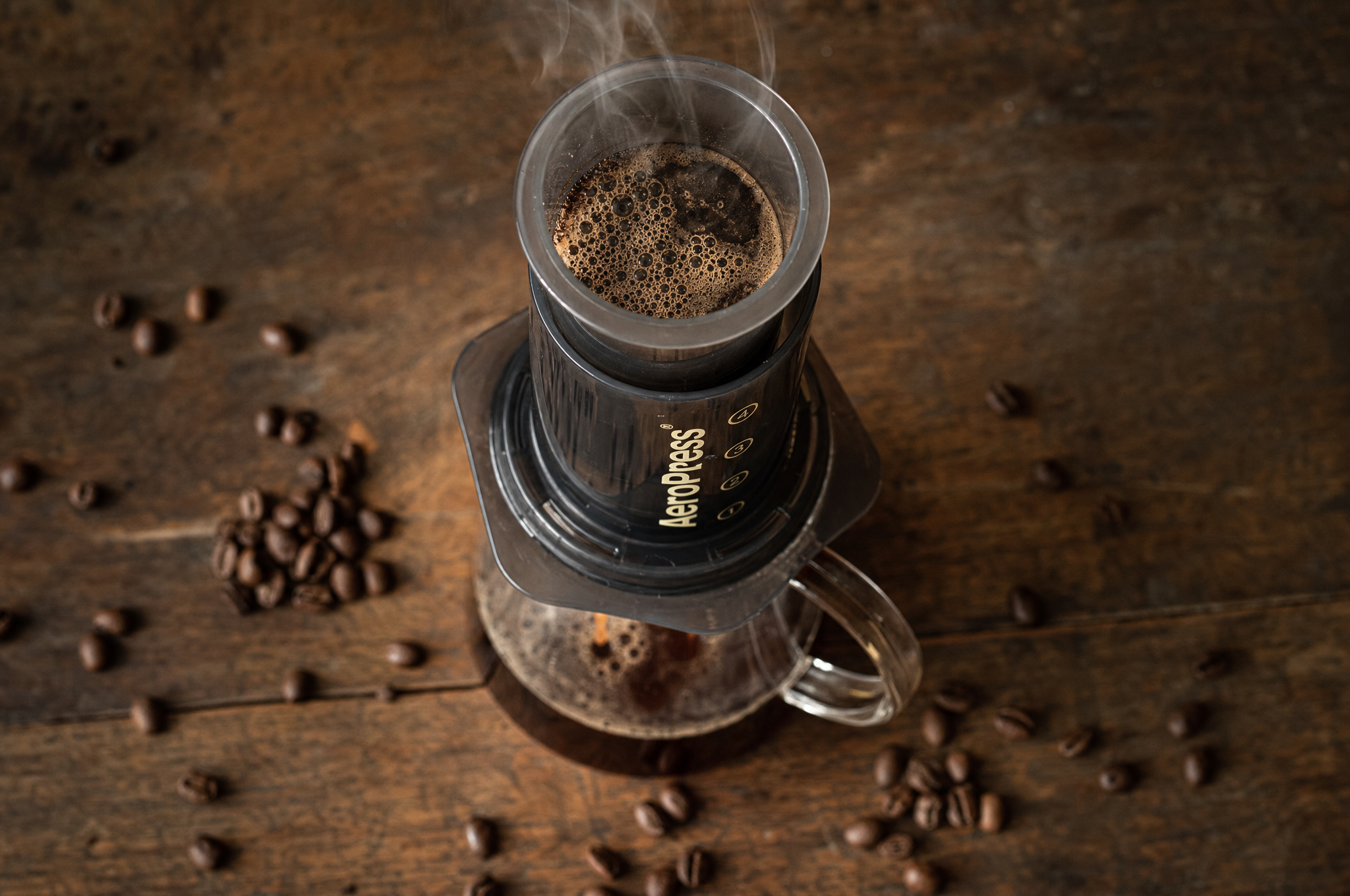
Feels like fine table salt between your fingers. Individual particles are visible but small, and the grind has a uniform, almost sandy appearance. This is the espresso range — fine enough to create the resistance needed for 9 bars of pressure to push water through in 25-30 seconds. If you have an AeroPress and want a quick, intense brew, a fine grind also works well with short steep times.
3. Medium-Fine (Slightly Coarser Than Table Salt)
Think of the texture of sand on a beach — visible individual grains, but still quite fine. This is the sweet spot for pour-over methods like the V60 and Kalita Wave. It's also ideal for the AeroPress if you're using a standard (non-inverted) method with a 60-90 second brew time. If you're using an AeroPress, check out our complete AeroPress guide for recipe recommendations.
4. Medium (Sea Salt)
Looks like coarse sea salt — clearly individual particles, each one distinct to the eye. This is the most versatile grind and the one you'll use for drip coffee makers, the Chemex (with a slightly longer pour), and some AeroPress recipes. If you're not sure where to start, start here. Most pre-ground supermarket coffee is around this setting.
5. Medium-Coarse (Rough Sand)
Think of the texture of rough sand or small gravel. Each particle is clearly visible and distinct. This is the Chemex sweet spot (the thick filter requires a slightly coarser grind to prevent stalling), and it also works well for some pour-over recipes that use longer brew times.
6. Coarse (Cracked Pepper)
Looks like coarsely cracked black pepper — large, irregular chunks. This is the French press range. The coarse grind allows for a 4-minute steep without over-extracting, and the large particles are easier to filter out with the mesh plunger. If your French press coffee tastes bitter, your grind is probably too fine — read our French press reset guide for a full troubleshooting breakdown.
7. Extra Coarse (Large Chunks)
Large, irregular chunks that look like crushed nuts. This is cold brew territory — when you're steeping coffee for 12-18 hours, you need a very coarse grind to prevent over-extraction. A finer grind for cold brew will produce a muddy, bitter cup. If you're exploring cold brew, our cold brew vs iced coffee comparison explains why the long steep requires this specific grind.
Quick Reference
Turkish = powdered sugar · Espresso = table salt · Pour-over = beach sand · Drip = sea salt · French press = cracked pepper · Cold brew = crushed nuts
Uniformity Matters As Much As Size
Grind size isn't just about the average particle — it's about consistency. A good grinder produces particles that are all roughly the same size. A bad grinder (specifically, a blade grinder) produces a mix of dust and chunks, which means some particles over-extract (the fine dust) while others under-extract ( the large chunks). The result is a cup that's simultaneously bitter and sour — muddy and confused.
This is why burr grinders are non-negotiable for good coffee. A burr grinder crushes beans between two abrasive surfaces set at a specific distance apart, producing a consistent particle size. A blade grinder chops beans with a spinning blade, like a blender — it has no mechanism for controlling particle size. If you're using a blade grinder, switching to even a cheap burr grinder will improve your coffee more than any other upgrade.
How to Calibrate Your Grinder
Every grinder is different, and the numbered settings on your grinder won't match someone else's. The only way to calibrate is to taste your coffee and adjust. Here's the process:
- Brew a cup at your current setting. Pay attention to the taste.
- Is it sour or thin? You're under-extracting. Grind finer.
- Is it bitter or astringent? You're over-extracting. Grind coarser.
- Is it balanced? You're in the zone. Note the setting.
- Repeat until the cup tastes how you want it to.
This process takes a few iterations, but once you find your setting for a given method, you can lock it in. Just remember: when you switch beans, you may need to adjust slightly. Denser beans (like high-altitude Ethiopian coffees) grind slightly differently than less dense beans (like Brazilian naturals).
The Freshness Factor
One last thing: grind your coffee right before brewing. Ground coffee loses its volatile aromatics within minutes of grinding — the CO2 that carries flavor compounds escapes rapidly once the bean is broken. Pre-ground coffee is already stale by the time you open the bag, regardless of how it's stored. If you're buying pre-ground, you're losing most of the flavor that makes specialty coffee worth buying in the first place. For more on this, read our guide to storing coffee beans — the rules for freshness apply to whole beans, but they're even more critical for ground coffee.
Matching Grind to Method
Here's a quick-reference table you can come back to:
| Brewing Method | Grind Size | Visual Reference |
|---|---|---|
| Turkish | Extra Fine | Powdered sugar |
| Espresso | Fine | Table salt |
| AeroPress | Medium-Fine | Beach sand |
| V60 / Pour-Over | Medium-Fine | Beach sand |
| Drip Machine | Medium | Sea salt |
| Chemex | Medium-Coarse | Rough sand |
| French Press | Coarse | Cracked pepper |
| Cold Brew | Extra Coarse | Crushed nuts |
Once you internalize this spectrum, dialing in your coffee becomes much more straightforward. The grind is the foundation — get it right, and everything else falls into place. Get it wrong, and no amount of technique will save the cup.